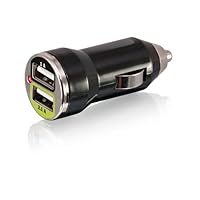
- Fast charging for multiple devices, including iPad, iPhone/iPod,MP3 and smartphone
- Low profile charger fits into any 12v port
- 2.1A and 1.0A USB ports
- Fast charging for multiple devices, including iPad, iPhone/iPod,MP3 and smartphone
- Low profile charger fits into any 12v port
- 2.1A and 1.0A USB ports
- Power LED Light

This product, in unaltered form, suffers from a couple problems:
1. Despite what the description says, it's designed for Apple products, not for other products like Android. I find the description quite deceptive because it will NOT deliver the current one expects for most Android devices (or the HP Touchpad as well).
2. While it claims a 2.1A port and a 1A port, implicitly suggesting 3.1A total, it can not actually deliver 3.1A no matter what device you have (including Apple). It delivers a total of 2.1A.
However, by cracking open the case and shorting the data lines, something VERY easy to do with this device if you're at all competent with a soldering iron, you get an awesome unit for Android devices, and it's THE ONLY ONE (that I've found), that will charge an HP Touchpad at full capacity (more details below).
Now to the details...
A little background on USB charging for those who don't know:
The USB power spec is for 0.5 Amps at 5 Volts... or 2.5 Watts. This was great up until the last couple years when devices have gotten really power hungry, particularly smartphones and tablets and to a lesser extent dedicated GPS's. Some of these devices use over 2 Amps, particularly the tablets like the iPad (or in my case the HP Touchpad).
Manufacturers of these devices therefore had a dilemma. If they had their devices pull more than 0.5 Amps, they risked damaging the power source, which could be a computer, that was only prepared to source 0.5 Amps. Thus the manufacturers have used tricks to determine whether their device is connected to an unknown source, at which point they purposely only draw 0.5 Amps, or to the dedicated charger that was provided with the device, where they can draw all the power they need.
There seem to be two common tricks used. The first is to short the two data-wires together in the charger. This is what most non-Apple devices do. Since a computer or older device wouldn't have done this, the device can assume it is safe to draw all the power it needs.
Apple seems to have taken a different approach, one that I don't fully understand but know can be seen by the fact that the data lines are neither open nor shorted when the charger is plugged in, and is more sophisticated and probably superior, because I suspect it allows the device to know exactly how much power it can use.
While Apple taking a better approach might be nice in concept, it's created chaos in the USB charger product category. What is the non-specific charger to do? They can't support both.
This device chose to go the Apple route for both ports. While the PowerGen unit I purchased (see below for links to the others I've purchased) had the 1 Amp port setup for Android (data lines shorted) and the 2 Amp port for Apple, this device, like the others, has both setup for Apple. I don't own any high-power Apple devices, so I can't say for sure, but I suspect this unit performs well with Apple devices out of the box.
But because I had bought 4 of these and they all had the same problem (except the PowerGen, which only had it on one port), I decided it was time to get down and dirty and see if I could open any of them up and modify them by shorting the data lines. This was the ONLY ONE that was easy to open without damaging the casing. Just unscrew the silver cap at the top and then pop off the silver plate on the bottom and it easily splits apart. Then there are two sets of 4 pins, one on either side of the circuit board that runs up the middle that are somewhat obviously the pins to the USB port. A solder blob on the middle two pins to short them together is all that is needed. It took longer for the old soldering iron to warm up than to do both sides. Reassembling took a bit of careful placement of the parts, but it wasn't too difficult and then all that's required is pushing back on the bottom plate and re-screwing in the cap. The whole operation took 5 minutes.
It bears repeating: NONE of the others were easy to get apart.
When I tested it afterwards, it performed beautifully with my android devices, just like I expected from my above explanations. I got an additional bonus that I didn't expect with the HP Touchpad that requires some additional explanation.
See, the HP Touchpad, while it's charger has the data lines shorted, also does something else. It requires a specific voltage be on the data lines. Thus it doesn't work with chargers that just have the data lines shorted, including the PowerGen mentioned in this review.
There is a way to modify a charger further to get it to work with the HP Touchpad, by adding resistors to one's charger, but frankly, that was more work than I was willing to do. However, whether it was luck or genius, the 1 Amp port on this device already has some resistive elements for the Apple charger setup, and when one shorts the data lines together, it gives the required voltage for the HP Touchpad to charge. NICE FREE BONUS!
Now, because this device can only source 2.1 Amps total, it'll be a little overpowered if you connect both the HP Touchpad (or an iPad for that matter) and a smartphone, but even when I did that, it continued to charge, just perhaps a bit more slowly than it would have if it could deliver all the current each desired.
And it bears repeating that this is THE ONLY DEVICE I am aware of that can fully charge an HP Touchpad (after modification).
Thus this device gets docked to 4 stars because it claims out of the box to support a number of Android devices that will not work as expected without modifying the device. I suspect it will work well with Apple devices including the iPad (I don't own any). It also gets dinged because of the deceptive amperage claims.
Frankly, I am a bit uncomfortable giving 4 stars for something that requires modification to meet my needs, but because all the devices I tested have the same problem it made it easier to give it a 4 considering the ease of the modification and the nice bonus of the HP Touchpad charging.
For those who don't have Apple devices, I ordered three additional devices:
"PowerGen Dual USB 2A Heavy Duty Ouput Car Charger" (http://www.amazon.com/gp/product/B00622AG6S/ref=oh_o06_s00_i00_details)
"Kensington K33497US PowerBolt Duo Car Charger" (http://www.amazon.com/gp/product/B003PU01M4/ref=oh_o03_s00_i00_details)
XTG "Ultra Compact High Output Dual USB Car Charger" (http://www.amazon.com/gp/product/B00470C35E/ref=oh_o02_s00_i00_details)
I have written a review on each of them with more details.
I kept this one after the above modification and the PowerGen in unmodified form and returned the Kensington and the XTG.
Buy Bracketron Universal Dual USB Car Adapter (UGC-298-BL) Now
While this Bracketron USB Car Adapter isn't fancy, it does exactly what it promises: giving you two USB ports for one cig outlet. Because it's fairly short, it maintains a low profile and only protrudes about 3/4" from the cig outlet opening -low enough to not look ugly, but long enough that you can grip it to pull it out.When it's in a cig outlet that's active and it's receiving power, the little red LED activates. I'm very glad they chose red, as it's bright enough to be seen, but doesn't blind you at night like green or blue LEDs tend to do. I have confirmed that the 2.1A works with a 1st-gen iPad (which are finicky about getting enough juice to charge), and both ports can power any USB-powered device (yes, the 2.1A can power your phone without hurting it).
How I use it in Real Life(tm): I have 2 cig outlets in my vehicle, but I have 3 devices to charge: a Sirius radio, a TomTom GPS, and my phone. I almost bought a cheaper device on woot.com, but a comment suggested the Bracketron here on Amazon instead. Giving it a shot, I put the Bracketron adapter in the outlet that is always on (even when the vehicle is off), and use it to power both my TomTom and my phone. If I need to charge my iPad, I plug it into the 2.1A port. The Sirius radio continues to be plugged into the outlet that deactivates when I turn off my car's ignition. Since my phone doesn't pull a lot of juice to charge and the TomTom is usually off (or removed from view alltogether), I don't fear it draining my battery.
Summary: Thank you, random woot.com user! This product, while more expensive than similar devices, does exactly what I needed: charge 2 devices, including an iPad if I need to. In addition, it maintains a low profile and looks great.
Pro's
+ 2 ports, including 2.1A port
+ Low profile, yet easy to remove
+ Works with iPads!
Con's
A bit more expensive, but worth it
Doesn't equip my car with laser cannons or machine guns.
Read Best Reviews of Bracketron Universal Dual USB Car Adapter (UGC-298-BL) Here
Many good things about this little guy. That was one: it is small and unobtrusive. The next is that it can handle a running iPad AND an iPhone at the same time!! Lastly, it seems to be built very well. Unlike others I've bought, I'm not afraid of this one disassembling itself.Just buy it!
Want Bracketron Universal Dual USB Car Adapter (UGC-298-BL) Discount?
It works perfect. Charges both devices quickly. It protrudes from your 12 volt port by maybe 3/4 an inch or so. To me it's just the right about to get a grip from removal. Be aware that the LED will be lit the entire time it's plugged in, not just when "in use."Save 63% Off
This adapter is sturdy, small, and stylish. When plugged into my smartphone near 100% charge, it makes a great deal of audible squeaking noise that appears to be due to the smartphone pinching off the input current. The noise disappears for higher loads (e.g., smartphone at

No comments:
Post a Comment